Thursday, 28 May 2015

Not West Bridgford No. 8


In the first of these “Not West Bridgford” blogs I mentioned the Tudor Cinema, which used to stand on the corner of Central Avenue and Rectory Road – in what is now (ironically) called Tudor Square (it wasn’t called that when the cinema was there). I noted the influence of the Tudor style in other parts of West Bridgford. So on Tuesday afternoon this week it was a real pleasure to go along to an excellent illustrated talk about the Tudor Cinema by Bob Massey, given at West Bridgford library.

As well as some of the cinematic history, and events such as air raids and floods which impacted upon the locality, the speaker provided a considerable amount of architectural detail.  The Tudor’s architect was Alfred John Thraves, who worked for a practice in Victoria Street in the centre of Nottingham. Thraves also designed a precursor, very similar in overall appearance, but sadly now a Chinese restaurant - in Bourne, Lincolnshire. A later clone of the Tudor appeared in West Kirby on the Wirral, and another related Thraves design – never actually a cinema but still surviving among a row of shops – can be seen in Mansfield Road, Sherwood, on the north side of Nottingham. Any of these might have made it into “Not West Bridgford” – although only the Sherwood example was known to me prior to Bob Massey’s talk.

The Tudor lasted only from 1931, shortly after the introduction of “talkies”, until 1959, when the mass acquisition of TV sets was well under way. Despite protests, the cinema was demolished and replaced by a design-free two storey block – currently this block includes an Iceland supermarket, a Thomson’s travel agency, and the Shalimar restaurant. When a photograph of this architectural masterpiece was presented at Tuesday’s talk there was a titter of amused derision among the audience, who were all of a certain age and able to recognise retrograde progress when shown it. Lets face it, they’ve had a lot of practice.

If – back in the Fifties - one stood on the steps of the Tudor one could look in an easterly direction, straight up Davies Road towards the edge of the built up area, half a mile away, in the direction of Gamston Bridge. On this side of West Bridgford are several long straight roads – Davies, Blake, Eltham, Burleigh, Stamford and Leahurst among them which – very subjectively it has to be admitted – offer a strong sense of “east”, the direction from which the new day arrives, and towards low land adjoining the Grantham Canal, with allotments and so forth. Despite new building at Abbey Park and Gamston this visual impression is still available today.


To illustrate this blog posting with a “Not West Bridgford” example I offer a photograph of part of a shopping parade at Beacontree Health, on the east side of London, close to Dagenham, where there is also this strong sense of easterliness. It’s sort of suburban Co-op Arts and Crafts architecture, between-the-wars, slightly ramshackle. With a little imagination these shops could be in West Bridgford – at Abbey Road, Brockley Road or Hilton Crescent, perhaps.

Wednesday, 13 May 2015

Not West Bridgford No. 7


It was gratifying last week to see that fabled supergroup The Catford Tendency’s video of “Dream Politicians” had received approximately 200 views on YouTube in the four days between release and the start of polling. After which, as expected, it stalled and stiffed. Huge thanks to all those who privately offered kind comments on the song and the video; positive feedback is always so encouraging and rewarding, and your support is greatly appreciated.

Meanwhile, West Bridgford looks much the same after the election. Ken Clarke is still the MP, albeit with his habitual majority eaten into by UKIP, a party that for some reason appears to do well in seaside resorts. West Bridgford, being slap bang in the middle of the country could not be less like a seaside resort, although in its quintessentially suburban nature it shares much stylistically with the likes of Durrington-on-Sea in West Sussex, Frinton in Essex, and Ansdell in Lancashire. A little to the north of Ansdell, bordering Blackpool, is St. Anne’s, conventionally coupled with Lytham.


The photo shows a typical thoroughfare in St. Anne’s, just off the seafront on a summer’s evening, and the scene reminded me - overall, though not in detail - of the area around Cyril Road in West Bridgford, the subject of a painting, shown below, that I perpetrated last year called “Brownes’ and Bellamys’”, named (with conceited allusion to Andrew Wyeth) after former residents.

Sunday, 3 May 2015

Not West Bridgford No. 6 … and “Dream Politicians”


West Bridgford is often thought of as one of the most affluent parts of Nottingham, yet it includes areas hinting at pretty well all socioeconomic levels, and is very mixed, even within individual thoroughfares. This intense sense of variability, from one road to the next, is a factor that enhances the sheer interestingness of this suburb. It is also perhaps reflected in the ironic nickname “bread and lard island”, where the inhabitants wear “fur coats and no knickers”. The demographics include a large student population and many elderly people.

A general tendency – with a great many exceptions – is for the affluence to increase the further south in the district one goes and – as in Hollywood – wealth tends to correlate with altitude. Some of the most wealthy thoroughfares, not just in West Bridgford but in the East Midlands as a whole, are up the hill in the direction of Edwalton (itself very mixed), and include Valley Road and adjacent roads such as Croft Road and a stretch of the main A606 Melton Road. The picture below looks a lot like part of Valley Road, but is in fact Dulwich Wood Avenue, in Dulwich, one of the richest and leafiest suburbs of south London.


Somewhere along the wealthiest stretch of Melton Road resides Kenneth Clarke, who has been the Conservative MP for Rushcliffe for longer than anyone can remember. He’s standing for Parliament again in the general election of 7th May, and there will be gasps of surprise if he isn’t returned with his customary huge majority. Which gives me an excuse to plug a performance by one of my favourite bands, the Catford Tendency, and their gently whimsical political song “Dream Politicians” https://www.youtube.com/watch?v=MHv1P1Nu2Cc&feature=youtu.be Click on the above to follow the link to the YouTube video, set to “full screen”, turn up the volume, and enjoy.

Friday, 17 April 2015

Not West Bridgford No. 5


The underlying and essentially pointless theme of these “Not West Bridgford” pieces is the discovery, in some other place, that one’s surroundings are reminiscent of a scene in the archetypally suburban district of West Bridgford, Nottingham. As well as, subjectively, needing architectural and/or atmospheric qualities to be present in order for this to happen, there can be something about the Proustian ‘involuntary memory’ phenomenon in all this: the unexpected stimulus, the absolutely trivial occurrence that powerfully triggers recollection.

Therefore it’s entirely appropriate that one of Marcel Proust’s special places should feature here. Cabourg, on the pleasant Normandy coast between Arromanches and Honfleur, was fictionalised by Proust as Balbec, the location of happy seaside holidays. Improbably, given its location, it’s uncannily Bridgfordian.
Cabourg’s central area is geometrically planned, with extensive open spaces, its architecture is undeniably French; the town possesses a long promenade and a fine sandy beach, and it survives delightfully out of time. For those who know Albert Road, in West Bridgford – as you make your way from Tudor Square towards Bridgford Park - how about this for its Cabourg equivalent:


Or better still, continue round into Edward Road and find, just a block or so to your left, not the aforementioned Park and the cut-through to the Co-op supermarket, but the sea. The cold waters of the English Channel are just over the horizon up the road on the left.


If we revert to an earlier discussion about the role of fake Tudor style as a default design form for West Bridgford, we might want to head a few miles along the coast from Cabourg to Deauville, where we can enjoy this:


In a way this is not so much “Not West Bridgford” as “More WB than WB”, a long forgotten childhood dream where a maroon-and-cream WBUDC vingt et un is purring at the stop outside Ethel Llewellyn’s, picking up passengers for its uphill journey to the rue Alford.

Wednesday, 8 April 2015

Not West Bridgford No. 4


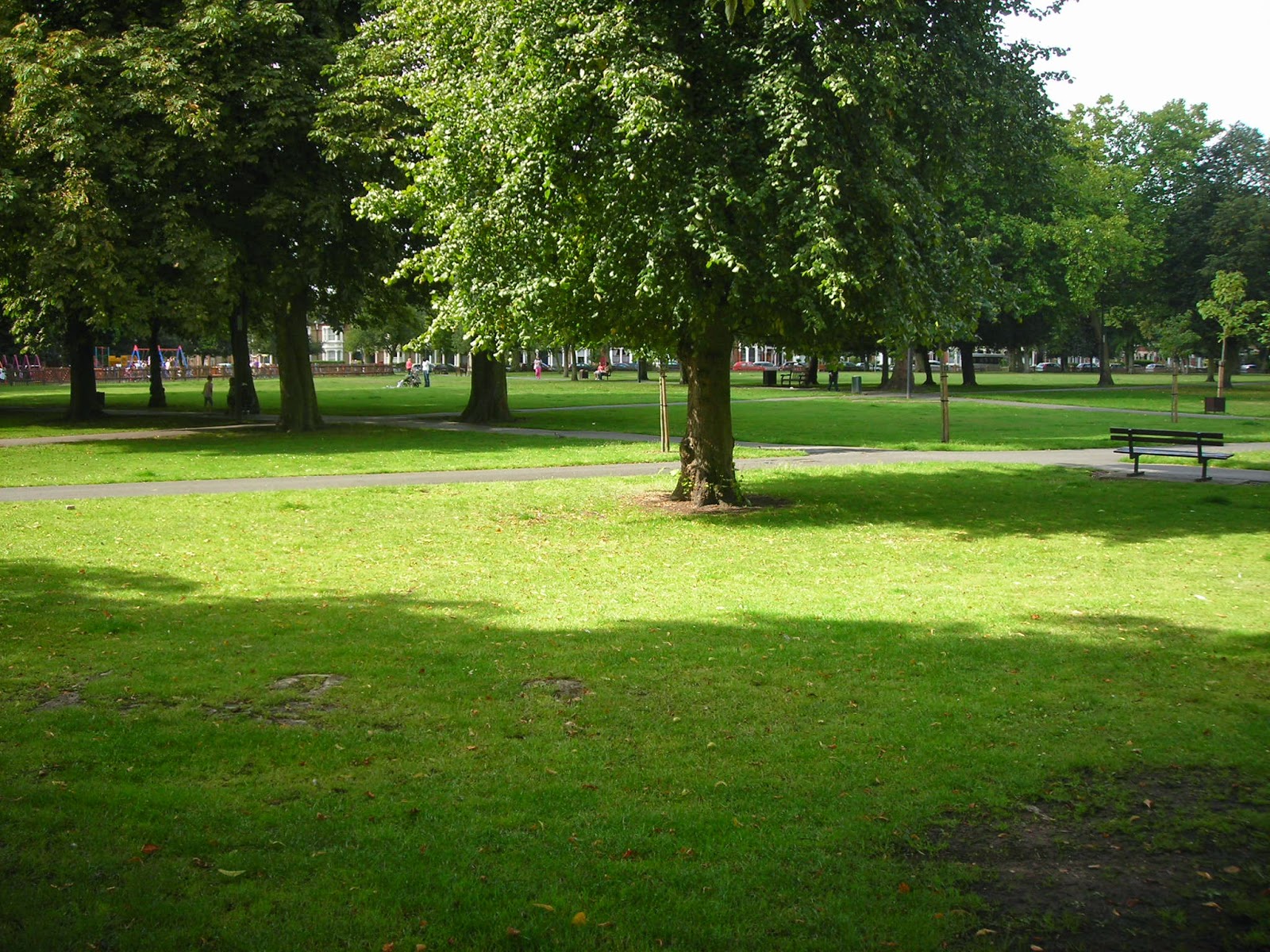
Bridgford Park is a small green gem, under constant threat of encroachment from unlovely shops and unlovelier car parks, close to the commercial centre of West Bridgford. Just a minute or two’s walk from Central Avenue it contains all the features one would expect of a suburban park, plus a couple of unexpected ones. Lawns, trees, flowers, flower baskets, places to sit, obviously; the usual amenities including tennis courts and a playground for children; but then less usual features like Bridgford Hall (a Georgian pile currently undergoing transformation into a hotel – expect more parking requirements), a set of stone steps from which one can mount one’s horse (although if one wants to mount it somewhere else I’m not sure what one is supposed to do), and – slightly less amusingly – a ha-ha.

The area between the central gardens and Albert Road used to be a treeless grassy expanse upon which several games of football or cricket could be played simultaneously. Several years ago trees were planted, transforming the appearance, and making the playing of games hazardously collision-prone. Such is progress. I’ll resist commenting on what “they” have done to the library.


The photograph is, of course, Not Bridgford Park, but the recreation ground adjacent to Wanstead High Street in East London. However, the view simulates the effect of looking into Bridgford Park from the Albert Road direction, with a vista under the large trees with their surrounding hexagonal benches, towards the Hall.